

 Blog
The Internal Consultant: The Missing Link Between Strategy and Change
Read the articleSuccessful onboarding helps new hires understand their team, find their place and connect with the wider organisation. Three keys to build team cohesion from the very first weeks.
 Reading time: 6 min read

Want to go further?
See the platform in 30 minutes, with an expert.
Share this article

A new hire's first few weeks are usually well mapped out. Welcome sessions, tools, key meetings and early goals are all planned so they can get off to a good start.
Then, little by little, that structure falls away. The newcomer has to learn the team's unwritten rules, work out who to go to for what, and find their place in the group.
For HR and managers, the challenge goes beyond getting someone up to speed in the role. It's about helping them become a full part of how the team actually works.
A new hire joins a team that already has its landmarks and its habits. They, in turn, bring their own drivers and their own way of contributing.
Two people hired into similar roles can experience the same onboarding programme very differently. One will want to pin down their role first; the other will need to grasp the bigger picture or build relationships before anything else.
A good onboarding programme offers a common foundation while making room for those differences. Managers can then tailor their support to what each newcomer needs and to how they are settling into the team.
What energises a new hire can also shed light on how they will contribute to the team. These are the activities they genuinely enjoy and that give them energy. The Map & Match approach captures them through Energy Skills™, revealing how each person contributes and where they complement the rest of the team.
The new hire gets a clearer sense of what they can bring. The team, for its part, understands how to work with them and make the most of their strengths.
That mutual understanding lays the groundwork for onboarding. It then has to show up in day-to-day work and help the newcomer find their way around the team.
Effective onboarding rests on three complementary dimensions.
The org chart gives a first view of who is responsible for what. But a team also runs on informal roles, shaped by working habits and day-to-day interactions.
For a newcomer, knowing who the key people are and how decisions really get made makes it much easier to get a handle on their environment.
Map & Match can add to that picture by making everyone's way of contributing more visible. It helps spot the roles some people naturally take on and how those roles fit together.
The new hire finds their bearings far more easily.
Onboarding also depends on finding the right information at the right moment.
A resource is only useful if it's easy to find and makes sense in context. A new hire might have a procedure in hand, for example, without knowing when it applies or who to ask to make sense of it.
Linking information to the people and projects it relates to makes it far easier to use. A collaborative workspace such as Jamespot keeps those links alive by grouping resources with the projects and communities they belong to.
An organisation might, for instance, set up a dedicated newcomers' page on its intranet and turn the questions new hires ask into an FAQ for the people who join after them.
Knowledge that is easy to reach and comes with its context cuts down on trial and error — and helps people work independently sooner.
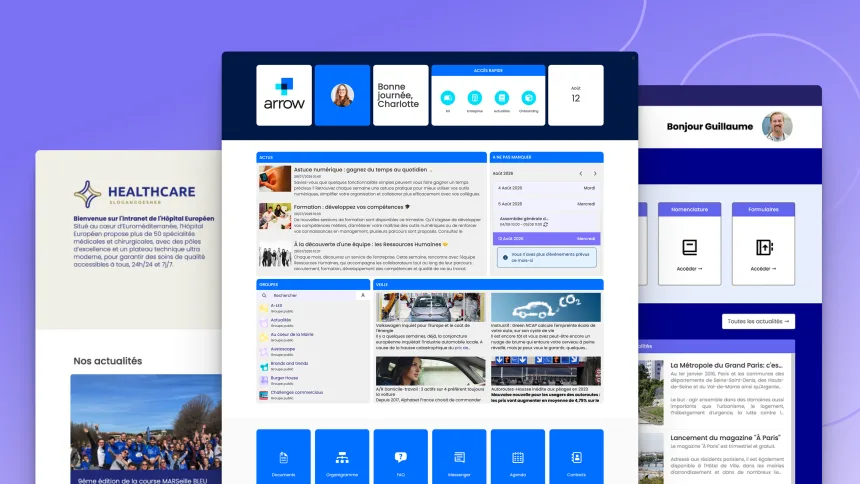
The first meetings help the newcomer discover the organisation. Their onboarding then carries on through projects and everyday exchanges, particularly in internal communities and discussion threads. By taking part, they pick up how the organisation works and gradually get involved in the topics that matter to their role.
Jamespot makes that participation easier by opening up access to the right communities and conversations, rather than relying solely on the introductions arranged during the first few weeks.
New hires can join the groups linked to their job or their projects and find shared documents and past discussions there, without having to ask for everything all over again.
That's when they really start to take part in the life of the team.
The manager plays a central role in the first weeks, but onboarding also involves HR and the wider team. HR shapes the programme, while colleagues support the newcomer's arrival day to day.
That shared involvement gives the new hire several people to lean on, so their onboarding doesn't rest on their manager alone.
Their arrival also prompts the team to write down things that had only ever been passed on informally. This makes them easier to hand over — and makes the way the team works far clearer to the newcomer.
Onboarding doesn't stop after the first few weeks. New hires need to keep understanding the place they can take in the team, while staying connected to the information and the people their work depends on.
Map & Match and Jamespot work on these two complementary dimensions.
Map & Match makes the drivers, contribution styles and complementary strengths within a team easy to read. Jamespot provides a space where employees can find the knowledge, people and conversations that help them grow within the organisation.
One helps people understand the place each of them can take in the team. The other makes that team easier to reach, every day.
Together, they create better conditions for both onboarding and team cohesion.
Successful onboarding is about more than helping someone settle into a role. New hires need to understand how the team works, see where they fit and be able to take a full part in team life.
The team, in turn, needs to recognise what they bring and learn how to work with them.
By acting both on understanding human dynamics, with Map & Match, and on access to the team, with Jamespot, onboarding can strengthen team cohesion from the very first weeks.
Want a clearer picture of what drives a new hire and how they complement their team?
Let's talk about your context and your onboarding challenges.
Want to go further?
See the platform in 30 minutes, with an expert.
Share this article
BlogThe Internal Consultant: The Missing Link Between Strategy and Change
Read the article Blog
Energy at work: is a holiday really enough?
Read the article Blog
Workplace diversity: how people work, the forgotten lever of collective performance
Read the articleWe measure how this site is reached and used so we can improve it. These cookies are only set with your agreement, which you can withdraw at any time. Learn more