

 Blog
BlogEnergy at work: is a holiday really enough?
Read the articleEvery year, B Corp Month takes a theme. This edition puts the "B" of B Corp in the spotlight — the symbol of a practice of continuous improvement.
 Reading time: 5 min read
Want to go further?
See the platform in 30 minutes, with an expert.
Share this article

Every year, B Corp Month takes a theme. This edition puts the "B" of B Corp in the spotlight — the symbol of a practice of continuous improvement.
At Map & Match, B Corp sits directly inside the company's mission: transforming the way work is organised by putting people's enjoyment at the heart of individual and collective performance.
That conviction rests on a simple idea — lasting performance comes from environments where each person can find meaning and energy in their work.
It is written into the company's articles too, which state Map & Match's intention to generate a positive and significant social, societal and environmental impact, taking into account the consequences of its decisions on its stakeholders and on the environment.
Against that background, B Corp recertification does not call those founding convictions into question. With B Lab's new standards coming into force, it opens a new phase instead: giving more structure to governance and decision-making so that impact is fully part of strategy.
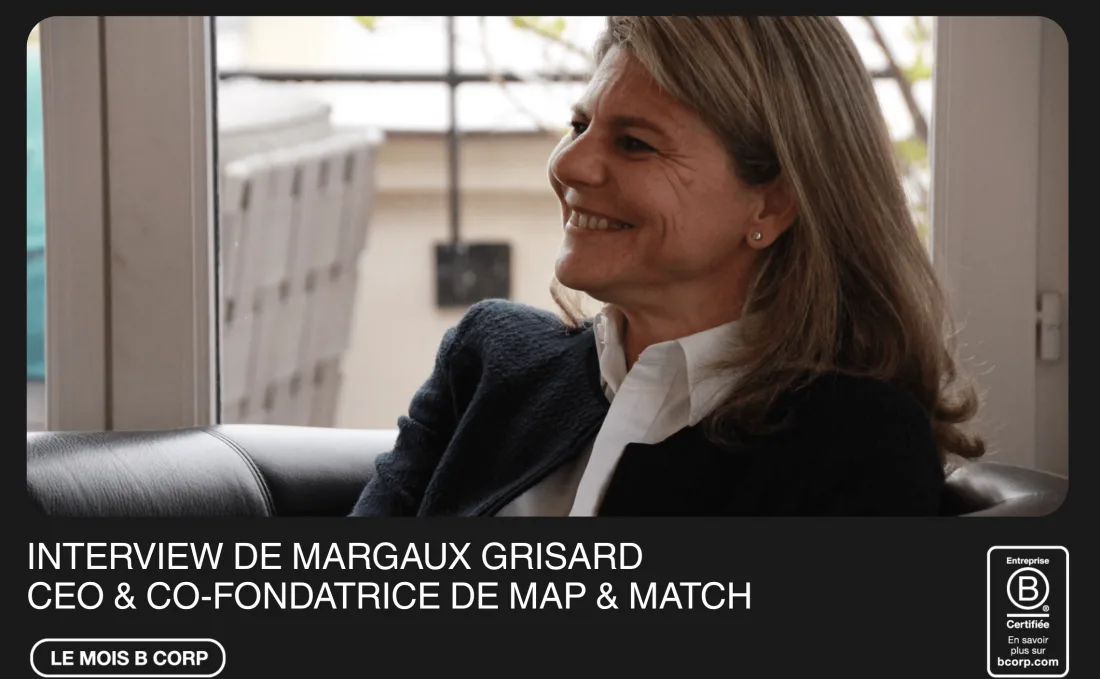
In this article, Margaux Grisard, CEO of Map & Match, sets out what that means for governance and for steering the business.
For a long time, a company's mission could be carried by its culture, by the convictions of its leaders and by consistent internal practice.
Recertifying against the new standards adds a further requirement: showing how that mission translates into formal mechanisms.
That means, among other things:
At Map & Match, that shift is not about inventing new commitments. It is about organising and structuring the ones already there.
"We have always carried these subjects with conviction. The new standards now ask us to formalise them and make them publicly visible."
The mission stops being carried by internal culture alone, and becomes a criterion built into strategic decisions.
The most significant change in this recertification concerns how decisions are made and followed up.
The new standards call for specific mechanisms:
What is left for Map & Match is to organise how all that is put into practice.
"Our mission is clear: transforming the way work is organised by putting people's enjoyment at the heart of performance. That principle already guides our strategy. The new B Corp standards lead us to look more systematically at the societal and environmental impacts of our decisions as well."
Today, an important decision has to be examined as much for its growth or profitability prospects as against criteria such as consistency with our purpose, potential human impacts, environmental implications and effects on internal equity.
"Respect for human rights, pay equity and progress on our climate plan now sit among the indicators we steer by, alongside the financial ones."
That approach calls for more preparation and more traceability. It changes the criteria we weigh, and it can make some decisions take longer. It also surfaces potential inconsistencies far earlier.
In an environment where consistency and transparency have become conditions of trust, that structure makes decisions more solid.
Recertifying against the new standards raises the level of formality required. That applies in particular to:
For a growing company, that means additional organisational work.
The point is not to pile up rules, but to state clearly the principles and criteria that guide decisions.
"Adding structure takes effort. But it narrows the room for interpretation and makes decisions more consistent."
Transparency about how pay is set, and formal inclusive hiring practices, leave less to interpretation and make sure that what is promised and what is done actually match.
"Certification creates a demanding frame that forces you to spot the gaps and deal with them."
Continuous progress rests on that capacity to adjust.
Recertification leads us to deepen the commitments we have structured, and above all to strengthen how they are carried out.
For Map & Match, that means:
This phase brings the room we have to improve into view.
"A strong culture is not enough. The new standards require formal policies, tracked indicators and public commitments. It asks for more rigour, but it also builds more credibility."
B Corp recertification is a moment of strategic clarification.
The new standards force us to give structure to commitments already there and build them into lasting mechanisms, to document what used to rest on intuition, and to bring impact into how decisions are made. That work takes time, calls for trade-offs, and needs leadership directly involved.
For Map & Match, this phase is not an end point but a deepening. It leads us to build human rights, internal equity, climate action and stakeholder involvement fully into how the company is run and grown.
"A committed company is not a perfect company. It is a company that accepts being assessed and improved continuously."
The "B" becomes a structuring frame: that of a company writing its responsibility into its own governance.
Find out more: Map & Match
Want to go further?
See the platform in 30 minutes, with an expert.
Share this article
BlogEnergy at work: is a holiday really enough?
Read the article Blog
BlogWorkplace diversity: how people work, the forgotten lever of collective performance
Read the article Blog
BlogStrategy execution: creating the collective momentum a transformation needs
Read the articleWe measure how this site is reached and used so we can improve it. These cookies are only set with your agreement, which you can withdraw at any time. Learn more