

 Case studies
Supporting executives in career transition: what the Map & Match and CDME partnership taught us
Read the case studyRolling out Map & Match at Jamespot is the story of a company growing steadily and paying close attention to how its teams work together. Based on an interview with Julie Petignat, Head of Customer Success, it traces an approach that began with the leadership team and was then run in-house. By understanding what each person is drawn to, the company reshaped how it manages, made cooperation easier and strengthened a shared culture in a remote-first setting.
 Reading time: 8 min read
Want to go further?
See the platform in 30 minutes, with an expert.
Share this article

Rolling Map & Match out at Jamespot is the story of a company growing steadily and paying close attention to how its teams work together day to day. This article, based on an interview with Julie Petignat, Head of Customer Success, traces an approach that started with the leadership team and was then run in-house. By seeking to understand what each person is genuinely drawn to, the company gradually reshaped its management practices, made cooperation easier and strengthened a shared culture in a remote-first environment.
France's leading SaaS collaboration vendor, Jamespot has been designing digital workplaces for French and European organisations for more than twenty years. Modular, and deployable as an intranet, an enterprise social network or a full digital workplace, Jamespot helps organisations strengthen collaboration, project management and information sharing, with an ease of use and a catalogue of more than a hundred business apps.
In an environment where teamwork is central, understanding human dynamics quickly became a priority. That wish to anchor cooperation in something lasting and human is what led the leadership team to explore Map & Match.
"It was a period where we worked a lot on ourselves as a team, and Map & Match added its own piece alongside other workshops and methods. What made the difference is that our CEO immediately talked about extending it to the whole of Jamespot, and the leadership team was up for it."
The starting point came from Alain Garnier, Jamespot's CEO, who wanted to strengthen cohesion in the leadership team and lay the foundations of a more aligned collective.
There were two aims:
"Alain Garnier presented Map & Match to us as a way to build a 'One Team' leadership group — a cross-functional team that supports each other and transcends departments. The aim was to understand the team's complementarity better and, I think, the appetites we lacked."
For the debrief, the team chose to read the results together. That let them explore what the whole group is drawn to, get clear on comfort zones and irritants, and see far more clearly where each person could lean on the others.
"Personally, it let me accept my irritants and my appetites, and understand when to hand something over and who to lean on."
This first step brought a realisation: differences in how people work became readable — and, above all, complementary, and usable in the service of shared goals.
The leadership team saw tangible changes very quickly:
"Beyond anything measurable, it made us see our differences as something of value."
Some one-to-one relationships also became clearer thanks to the triangle map, which sheds light on cognitive approaches and makes differences easier to understand.
"The mapping also helps with conflict. In terms of individual relationships, the triangle map was particularly useful with one member of the leadership team, for example. I need to explore freely and she needs to analyse everything, and we improved the way we work on joint projects — I take care not to jump from one subject to another, and she is less put out by what looks like my scattering."
After that first phase, extending the approach to everyone felt natural. The leadership team was unanimous: it was positive, it valued people, and it fitted the Jamespot culture.
"It was Alain Garnier who suggested rolling the Map & Match approach out across the company, and the leadership team agreed immediately. Agreement came quickly because it is a positive tool: it reinforces individual value and it avoids sticking labels on people."
Reading appetites collectively had already proved useful in strengthening cooperation and installing a continuous improvement mindset, and that held at company scale.
"The collective dimension of Map & Match is probably the most important one for Jamespot. It runs company-wide, but also within each team, with continuous improvement in mind. The idea is to help everyone feel they are in the right place and be happy, or at least satisfied, in their work."
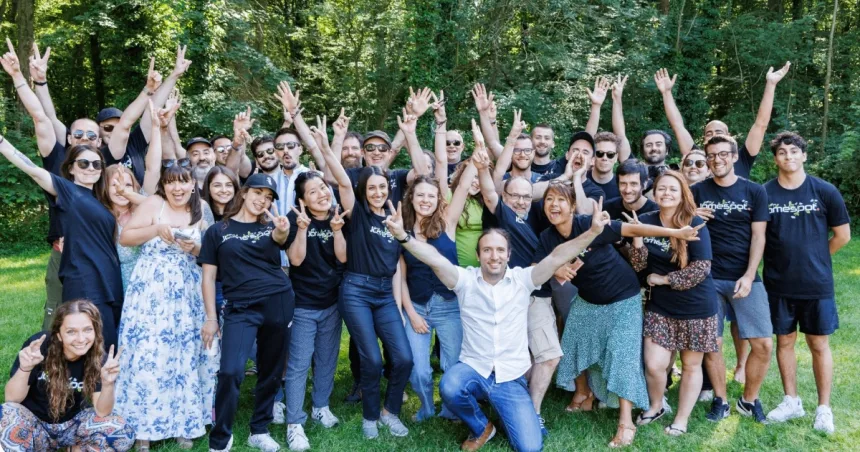
After the leadership debrief, the team was ready for the next step: identifying the contributions present in the company, understanding how they shape the way it works, and strengthening day-to-day collaboration.
"The idea was first to strengthen the overall dynamic, and to understand better which forces were at work in the way the company was moving forward."
Two members of the leadership team led the implementation. One took in-depth training before training the second, which secured solid, independent ownership.
The steps were:
Going through the individual step mattered. Even in an approach aimed at the collective, Julie stresses that you have to start from the person, get their agreement, and make sure they recognise themselves in the results before bringing them into group work.
"Once we have talked it through, answered the questions and redefined a few talents, the rest follows smoothly, and is met with real enthusiasm."
Map & Match is now part of everyday practice:
"Once a manager understands that handing the finishing touches to someone who has the talent for it will not make them miserable, projects run far more smoothly."
People gain in understanding of themselves and of others. Owning their appetites and their irritants helps them make sense of their successes as well as their difficulties. Feeling understood and recognised feeds motivation and improves the quality of relationships.
"For instance, someone with a connector talent led a project that called for exactly that, even though it is not in their job description. They put a lot of energy into it and it worked."
Managers use Map & Match to fine-tune how roles are split, support professional growth and delegate better. The point is to steer work towards natural talents, creating value for the team while letting the person take more pleasure in their job.
"As a manager, I try to align tasks — and development — with talents and comfort zones."
It also makes sense of situations where someone moves towards work full of their own irritants, and helps handle those choices thoughtfully.
Delegation, finally, is where the change is clearest:
"I have changed a lot on delegation. Some tasks weighed on me but I did not want to push them onto the team. With Map & Match, I understood who I could hand them to so that they became satisfying for the person doing them."
The rollout also made self-organisation easier, particularly in cross-functional teams. People pick up the map themselves to see what they can contribute and adjust how they work together.
"Map & Match becomes a self-organisation tool, not just a managers' tool."
For Jamespot, whose model is remote-first, keeping a strong culture is a daily challenge. Map & Match supports that management culture by valuing autonomy and motivation, both essential at distance.
"With distributed teams, we have to think every day about how we manage and about the collective dynamics. People's autonomy and motivation are essential, and Map & Match fits that view well."
What happened at Jamespot is not only an HR exercise: it is a way of supporting a shared culture, building trust and helping everyone find their place in a remote-first environment.
What stands out:
"Map & Match revealed the value of our differences."
For organisations looking to strengthen their collective dynamic, the Jamespot experience offers an inspiring perspective: understand what drives people, and work together better, for the long term.
Want to go further?
See the platform in 30 minutes, with an expert.
Share this article
Case studiesSupporting executives in career transition: what the Map & Match and CDME partnership taught us
Read the case study Case studies
What are the key success factors of an HR transformation?
Read the case study Case studies
How does a young start-up secure today's performance and tomorrow's growth?
Read the case studyWe measure how this site is reached and used so we can improve it. These cookies are only set with your agreement, which you can withdraw at any time. Learn more